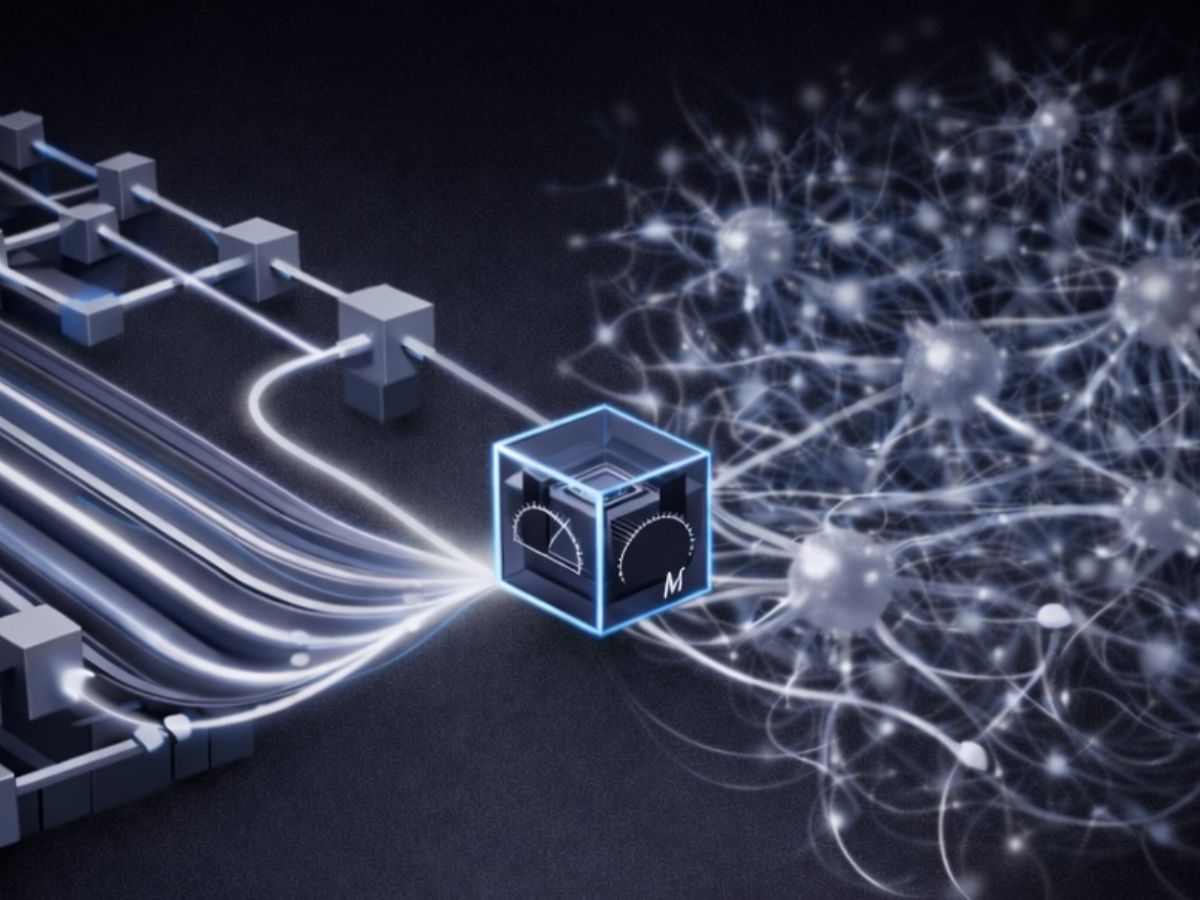
An international study, conducted in Italy by Cnr-Nanotec, the Italian Institute of Technology, and Sapienza University of Rome, has identified an unprecedented link between quantum physics and the theoretical models of artificial intelligence
An international study has revealed a surprising connection between quantum physics and the theoretical models underlying artificial intelligence. The study results from a collaboration between the Institute of Nanotechnology of the National Research Council (Cnr-Nanotec), the Italian Institute of Technology (IIT), and Sapienza University of Rome, together with international research institutions. The research paper was published recently in the journal Physical Review Letters (https://doi.org/10.1103/945c-11wt)
Italian researchers show that identical photons propagating within optical circuits spontaneously behave like a Hopfield Network, one of the best-known mathematical models used to describe the associative memory mechanisms of the human brain.
“Instead of using traditional electronic chips, we exploited quantum interference — the phenomenon that occurs in photonic chips when particles of light overlap and interact with one another to encode and retrieve information,” explains Marco Leonetti, coordinator and corresponding author of the study, senior researcher at Cnr-Nanotec and affiliated with the Center for Life Nano- and Neuro-Science at the Italian Institute of Technology (IIT) in Rome. “In this system, photons are not merely carriers of data, but themselves become the ‘neurons’ of an associative memory.”
The study also highlights the existence of a fundamental limit to memory capacity, analogous to that observed in biological systems.
“When the amount of stored information is limited, the system is able to retrieve it correctly thanks to quantum coherence,” adds Gennaro Zanfardino, currently research fellow at the University of Salento and first author of the study. “However, as the volume of data increases, a transition emerges toward a memory black-out phase, in which the system enters a state of disorder, technically defined as a spin glass, losing its retrieval capability.”
“These results open new perspectives for the use of quantum optics and integrated photonics in the development of artificial intelligence systems,” emphasizes Luca Leuzzi, co-author of the research, research director at Cnr-Nanotec and affiliated with Sapienza University of Rome. “Devices of this kind could ensure high performance with drastically lower energy consumption compared to current data centers.”
The implications of the study go beyond the field of artificial intelligence. The developed photonic platform makes it possible to simulate and investigate complex and disordered physical systems that are difficult to handle with conventional computers. In this context, the work fits within the tradition of theoretical physics of complex systems and establishes a conceptual bridge with studies on spin glasses that earned Giorgio Parisi the 2021 Nobel Prize in Physics. Not coincidentally, the discovery emerged within the same scientific environment in which Parisi developed his theories.
“With this study, of which we are particularly proud, we demonstrate that the laws of disorder observed in classical systems also emerge in quantum photonic circuits,” concludes Fabrizio Illuminati, director of Cnr-Nanotec and co-author of the research. “Light thus becomes a true miniature laboratory, capable of exploring the complex phenomena that govern natural and artificial systems, from climate to biological networks.”