ALTER-EGO is the first humanoid machine to assist clinical staff in caring for ALS patients
Humanoid robotics has taken a concrete step towards integration into everyday clinical operations with ALTER-EGO, the robotic platform developed by the Istituto Italiano di Tecnologia – IIT and the University of Pisa, and currently playing a central role in a pilot clinical experiment taking place at the IRCCS Maugeri Milano, as part of the Fit4MedRob projectfunded by the NRRP complementary national plan (CNP), with the aim of evaluating the integration of humanoid robot assistants in support processes for patients with neurodegenerative conditions, in particular Amyotrophic Lateral Sclerosis (ALS), both in hospitals and at home.
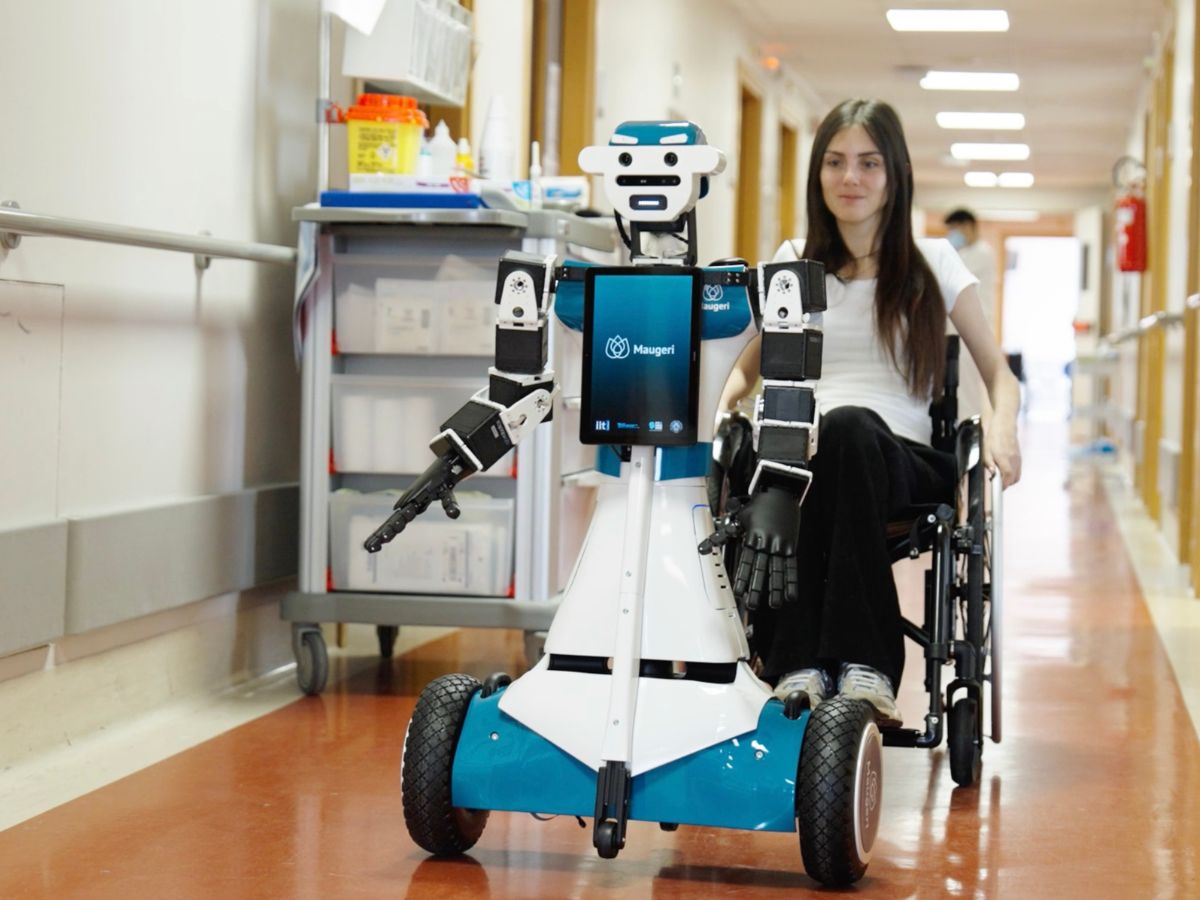
ALTER-EGO is a humanoid robot that stands around 120 cm tall and that moves on two wheels, either driven remotely by an operator, or in either autonomous or semi-autonomous mode. It is equipped with two arms comprised of variable stiffness actuators that operate as artificial muscles, allowing for adaptive and safe motion. ALTER-EGO uses SoftHand multi-jointed robotic hands to interact with its surroundings, which are capable, for example, of grasping and passing objects and of using handles through the application of the principles of Soft Robotics.
These characteristics allow ALTER-EGO to safely and gently interact with fragile patients and to operate in complex settings such as hospital wards. The robot may therefore be suitable as an assistant for clinical personnel in care activities, and to help patients in everyday situations.
The intuitive interface facilitates natural interaction and allows health workers to delegate repetitive and time-consuming activities to ALTER-EGO, freeing resources for tasks that require specialist or relational skills, which cannot be replicated by robots. The platform aims to optimise clinical work processes and improve the quality of support in cases of neurodegenerative conditions such as ALS. The areas of application have been defined in direct collaboration with health personnel.
In remote presence mode, ALTER-EGO acts as an avatar for clinicians who, via immersive control devices such as a visor and a joystick, can see through the video-camera eyes of the robot, use the hands and speak, for example to carry out remote follow-up sessions. These activities are typical of the home-care phase, in which the direct presence of healthcare workers is more difficult to organise.
In semi-autonomous or autonomous mode, ALTER-EGO is capable of carrying out repetitive, everyday tasks: welcoming and orienting hospital patients, as well as providing basic information and services, administering simple assessment measurement systems (for example VAS for pain) and accompanying patients in various daily hospital activities.
“The ALTER-EGO – (A)ssistive (L)iving and (T)reatment (E)nvironments for (R)obotic (E)quipment and (G)uided (O)perations – was launched a few years ago, and immediately focused on the use of humanoid robots in a particularly delicate phase of patient treatment, i.e., the return home following a period of hospitalisation, a phase that we know to be critical in both clinical and personal terms” – stated Dr. Rachele Piras, neurologist at IRCCS Maugeri Milan. “This led to the idea of using the ALTER-EGO robot as a tool to provide continuity between hospital and community care, not simply in terms of the “presence” of physicians, but as an extension of the entire multidisciplinary team (physiotherapists, nurses and psychologists), initially in remote operation mode (avatar) and then further on as an autonomous aid drawing on video, reminders and monitoring. The home assistance trials currently taking place at IRCCS Maugeri Milan represent the first practical step towards this future perspective”.
The project is particular not only in terms of technology but also with regard to method. From the outset, the study has adopted a multidisciplinary and participatory approach, which has seen the involvement of physicians, therapists, nurses, researchers, patients and caregivers. Focus groups, practical observations, feasibility analyses and studies focusing on usability with non-expert users have allowed realistic use cases to be identified, assessing the limitations, benefits and ethical implications.
“The aim of the process undertaken by Maugeri together with the Istituto Italiano di Tecnologia and the University of Pisa is to foster practical dialogue between clinicians and engineers, allowing technology to respond to practical clinical requirements, and allowing clinicians to fully comprehend the potential of technology”, commented Dr. Christian Lunetta,Director of the Maugeri Neuro-motor Rehabilitative Department.
“The focus groups involving all the end users are a particular aspect of this project, allowing us to identify the specific tasks for which personnel and patients consider the implementation of the robot to be truly useful”, explained Manuel Catalano, principal investigator of the NuBots research unit at the Istituto Italiano di Tecnologia – IIT. “In particular, ALTER-EGO has been conceived as a tool capable of lightening the workload of healthcare workers, allowing them to dedicate more time to activities that require clinical and relational skills. Furthermore, the results demonstrate that all the stakeholders involved have a positive approach to the robot, and that it is highly usable, even by non-experts”.
Six applicative macro areas have been identified: remote presence and remote support, support in everyday activities, delivery services, monitoring and safety services, reception and orientation, and rehabilitation support. The most promising scenarios for application include remote home care, in which the robot allows clinicians to provide support to patients and caregivers at home, as well as remote check-ups, basic monitoring activities and the facilitating of contact with family members.
“The project is also looking to the future: solutions are currently being developed to allow patients to directly control the robot via residual movements, transforming ALTER-EGO from an avatar of the clinician into a true personal aid”, stated prof. Antonio Bicchi, professor of Robotics at the University of Pisa and researcher at the Istituto Italiano di Tecnologia. “Overall, the study offers a replicable model for the responsible introduction of advanced robotics into areas of care, contributing to bridge the gap between experimental research and practical application. This is a significant step towards a more innovative and sustainable form of health care, focused on individual needs, in particular in terms of neurodegenerative conditions”.