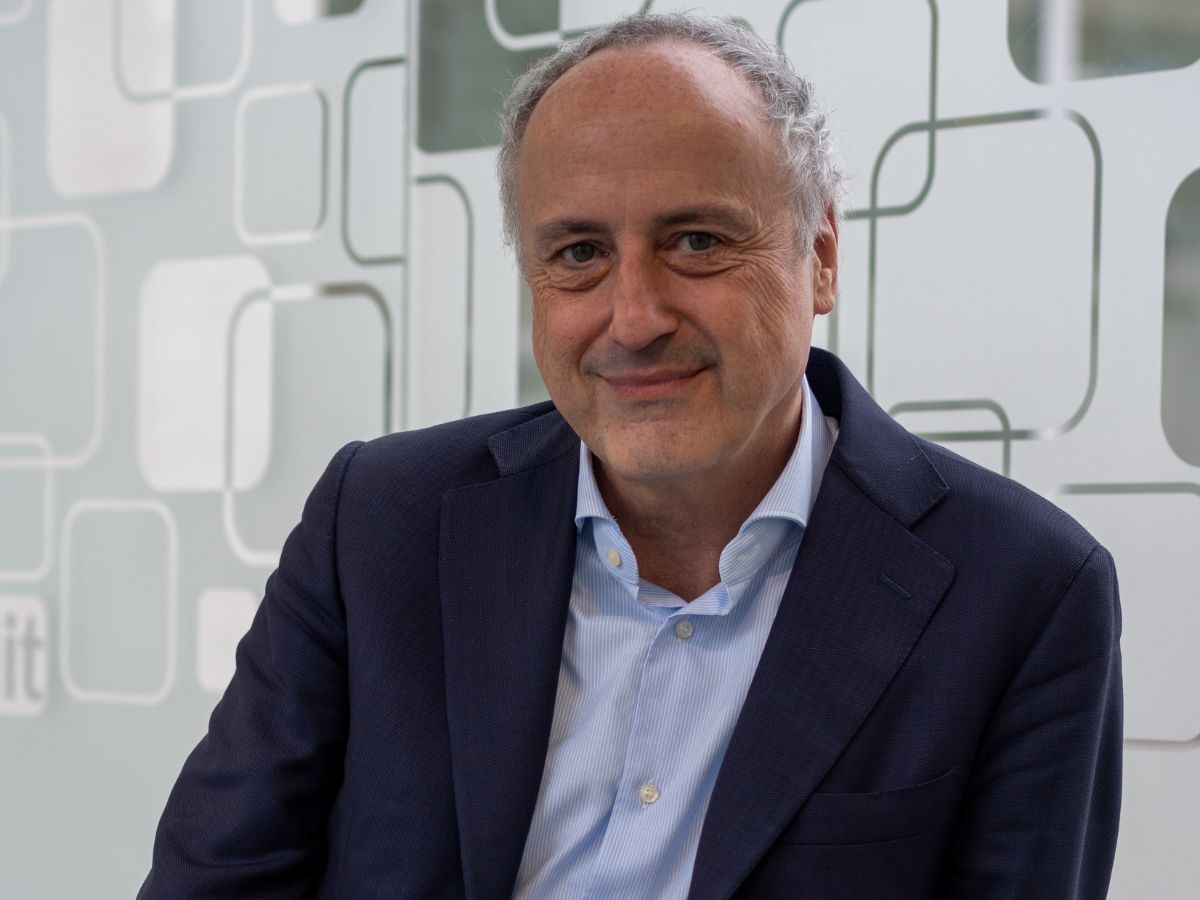
Interview with Stefano Gustincich, Director of the Center for Clinical and Computational Genomics (C3G) at IIT in Aosta and coordinator of the Non-coding RNAs and RNA-based therapeutics Research line
Stefano Gustincich refused to accept that the 98% of human DNA that does not encode proteins could be useless. By exploring this long-neglected genomic territory, he discovered a class of non-coding RNAs that regulate protein synthesis by increasing the amount of protein produced from messenger RNA. His group is now testing how to use them as a new type of drug: they can restore protein balance in numerous haploinsufficiency disorders, conditions caused by the malfunction of one gene in a pair, leading to insufficient production of a specific protein. The aim is to treat often disabling diseases for which no therapies currently exist.
«I have devoted my scientific life to demonstrating that the DNA once considered useless – the 98% that does not participate in protein synthesis – is anything but useless. On the contrary, it performs crucial functions. »
This is how Stefano Gustincich describes his path. After earning a PhD in Molecular Genetics and Biotechnology at SISSA in Trieste, spending ten years at Harvard Medical School in Boston, and returning to SISSA as a faculty member, he is now Director of the Center for Clinical and Computational Genomics (C3G) at the Italian Institute of Technology (IIT) in Aosta and head of the research line “Non-coding RNA and RNA-based therapeutics” at IIT’s Center for Human Technologies in Genoa.
Starting precisely from non-coding RNA molecules (RNA being the intermediary that carries genetic information from DNA), Gustincich is developing a new class of drugs, currently in preclinical testing, that could provide treatments long lacking for many diseases, particularly of the nervous system. At the same time, at the Aosta Center for Clinical and Computational Genomics, his team is sequencing the entire genome of thousands of individuals with neurodegenerative and neurodevelopmental disorders.
«What could be more appealing to a scientist than an unexplored territory? » Gustincich asks.
His work began with attention to what for decades remained a largely obscure domain: the vast proportion of DNA (and therefore RNA) that does not directly participate in protein synthesis – the function for which nucleic acids are best known – and which therefore lay outside the dominant research paradigms of the time. «At one point it was even labeled in the media as ‘junk DNA’» he notes, «although it seems rather odd to imagine evolution selecting such a large amount of useless material».
Why focus on the whole genome?
«We started from a dual observation. On one hand, genome sequencing long concentrated almost exclusively on protein-coding genes, neglecting most of the genomic landscape. On the other, beginning in oncology and then extending to many other diseases, it became clear how heterogeneous these conditions are. Tumor tissue may look similar, but in reality each patient’s cancer is different, because the genomic mutations that led to it vary from one individual to another. A cell can reach the cancerous state through multiple genetic routes, involving different genes. The consequence is that treatments also need to be diversified. In principle, one should design a specific drug for each case. That makes whole-genome sequencing essential, so that therapies can be tailored to the individual. This is now well established in oncology, but we are realizing that the same approach is necessary for nervous-system disorders, where truly effective treatments are still largely lacking».
A cultural shift in genomics
«In recent years at IIT, together with Andrea Cavalli and Antonio Amoroso, we decided to sequence entire genomes in order to understand the meaning and biological consequences of variation in the vast non-coding portion of DNA. In particular, we focused on transposons – simplifying somewhat, packages of repeated gene sequences – that make up about 20% of our genome and are highly expressed in neurons, yet whose function in humans remains poorly understood. In other species they move around the genome (hence the name ‘jumping genes’), but in humans they do so only rarely. What, then, is their role? We proposed an original model: that transposons give rise to non-coding RNAs with other functions, most of which remain to be discovered».
What did you discover about non-coding RNA?
«We isolated a new class of non-coding RNAs, which we called SINEUPs, and found that they regulate translation, i.e. the process by which a messenger RNA is converted into protein. They do not themselves encode proteins; rather, they bind specific messenger RNAs and enhance their translation. In simple terms, they boost protein synthesis, effectively doubling the amount of protein produced. When we studied their mechanism in detail, we found they consist of two parts: one responsible for increasing protein production, and another RNA region that precisely pairs with the target messenger RNA. In this way, they selectively determine which protein’s synthesis is increased».
Did this discovery lead directly to therapeutic applications?
«We immediately realized we could synthesize molecules capable of increasing the production of chosen proteins. The target protein can be selected by modifying the portion of the non-coding RNA that recognizes the messenger RNA. This opens major therapeutic possibilities, considering that about 400 human genetic diseases – currently incurable – are caused precisely by insufficient amounts of a protein. These are haploinsufficiency disorders, genetic conditions in which one of the two copies of a gene (one inherited from each parent) fails to function. The remaining gene produces only half the normal protein dose, with consequences that depend on that protein’s role. Here SINEUPs can intervene: they can double protein output. By modifying the targeting region, we can choose which protein to boost, restore physiological levels, and potentially treat the disease».
What stage has the research reached?
«Together with many colleagues who believed in this technology, we have obtained results in vitro in patient-derived human cells and in vivo in animal models. We are currently establishing a start-up to move into the clinical phase, i.e. human trials. We are focusing in particular on applications to diseases such as optic atrophy, Parkinson’s disease, and several forms of autism and epilepsy, which are linked to haploinsufficiency mutations in specific genes».
You are also collaborating with the national health system
«This is another side of the same coin. Achieving a diagnosis requires genome sequencing, and genomic data are essential both for treatment and for basic research. Diagnosis, therapy, and research are intertwined. The IIT Center in Aosta is certified as a clinical genetic analysis center. We are now arranging for sequencing analyses required by the health system to be performed here rather than outsourced across Italy or Europe, reducing both time and public cost. Meanwhile, research continues. In collaboration with Parini Hospital in Aosta, Professor Mandich at San Martino Hospital in Genoa, and Professor Di Fonzo at Ca’ Granda Hospital in Milan, we have sequenced more than 1,500 patients with Parkinson’s disease».
Do you study only the genomes of people with disease?
«On the contrary. A particularly interesting part of our work is the VdA Genomics project, which includes sequencing the genomes of healthy individuals from the Aosta Valley. We have already sequenced about 550. Remarkably, from genome sequences alone we can distinguish individuals with four grandparents from the region, three, two, or none – and even identify the specific valley of origin. Our broader goal is to help make future medicine sustainable and equally accessible to every citizen within the national health system. Achieving this requires developing two approaches in parallel: whole-genome sequencing for early, precise diagnosis, and RNA-based drugs such as SINEUPs, which offer the versatility needed to create personalized therapies, potentially even for a single patient».