JOiiNT LAB, a bridge bringing together research and industry, will be concentrating on how to transform traditional industrial organisations through the application of robotics and artificial intelligence, favouring human-robot collaboration and their co-evolution in the factories of the future
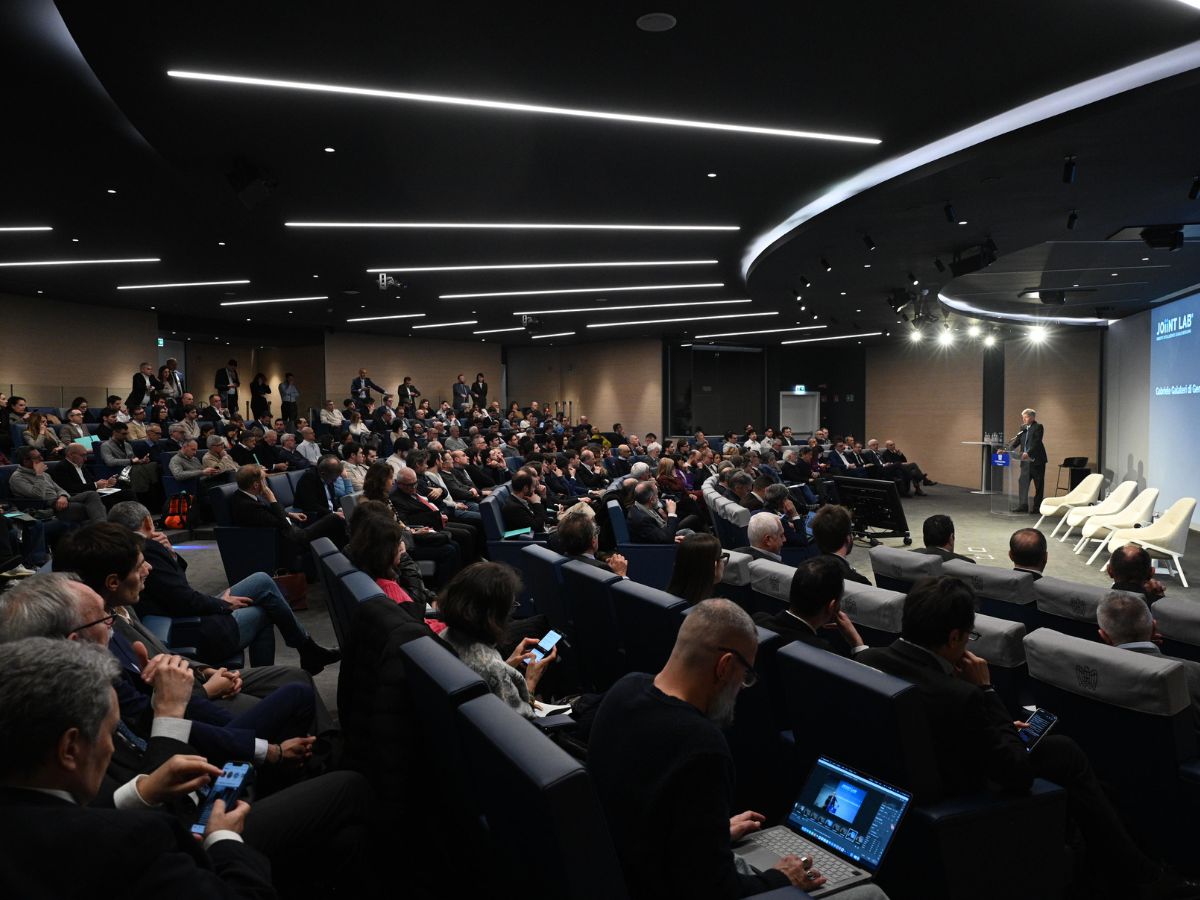
The event “Robotics and Artificial Intelligence for the Industry of the Future. JOiiNT LAB 2.0: the value of a public-private ecosystem” has come to an end. The event marked the official confirmation of an 11-year renewal of the agreement signed in 2020 between the Istituto Italiano di Tecnologia and the Intellimech Consortium, with the collaboration of Confindustria Bergamo, Kilometro Rosso and the University of Bergamo, and with investments from leading local enterprises, that led to the creation of the systemicJOiiNT LAB project. The renewal of the agreement involves an initial investment of approximately EUR 5 million.
The event, organised by the Istituto Italiano di Tecnologia, the Intellimech Consortium, JOiiNT LAB, Confindustria Bergamo, Kilometro Rosso and the University of Bergamo took place at the Innovation district Kilometro Rosso and began with institutional greetings from Giovanni Fassi, the vice-president of Confindustria Bergamo, Gabriele Galateri di Genola, the president of the Istituto Italiano di Tecnologia, Guido Guidesi, the executive councillor for Economic Development for the Lombardy Region, and Giorgio Gori, the vice-president of the Committee on Industry, Research and Energy (ITRE) of the European Parliament.
This was followed by speeches from Antonio Bicchi, head of the SoftBots research unit at the Istituto Italiano di Tecnologia and full professor at the University of Pisa, Giorgio Metta, the scientific director of the Istituto Italiano di Tecnologia, Gianluigi Viscardi, president of the Intellimech Consortium, Giovanna Ricuperati, president of Confindustria Bergamo, Sergio Cavalieri, dean of the University of Bergamo, Lorenzo De Michieli, director of Technology Transfer at the Istituto Italiano di Tecnologia, Manuel Catalano, coordinator for JOiiNT LAB and head of the new IIT research unit, and Salvatore Majorana, director of Kilometro Rosso.
Luca Orlando, a journalist for the newspaper Il Sole 24 Ore, was the moderator.
“The renewal of the agreement for JOiiNT LAB is a source of pride for IIT as it represents a successful example of possible collaboration between the public and private sectors. Specifically, JOiiNT LAB is a prototype joint systemic laboratory that allows a group of enterprises to jointly invest in long-term innovation activities of shared interest. This type of joint lab facilitates large-scale investment in research and development that individual companies would be unable to sustain alone, creating critical mass regarding strategic enabling technologies, and that is currently in great demand in Italy. It is a model of technology transfer that is replicable in other parts of Italy and in other sectors of industry”, commented Giorgio Metta, scientific director of the Istituto Italiano di Tecnologia.
“We are proud to be consolidating, through the renewal of the agreement with IIT, the role of Intellimech as a bridge between top-quality research and the manufacturing industry”, stated Gianluigi Viscardi, president of the Intellimech Consortium. “JOiiNT LAB is a unique model for public- and private-sector collaboration, in which technological innovation and human skills come together to create practical and applicable robotic solutions. This new investment, which has been rendered possible thanks to the local ecosystem and investments from champion enterprises as well as from IIT, will allow us to develop innovative technology, bolster technology transfer and train highly qualified professionals, contributing to rendering the factories of the future more flexible, sustainable and competitive”.
The main aim of the initial agreement from 2020, which was given access to more than EUR 5 million in investments, was to develop a joint laboratory in the field of robotics and mechatronics for industrial applications in the Bergamo area, one of the most innovative and competitive manufacturing districts in Europe, creating a practical link between the research activity carried out in the laboratories of IIT and the industrial needs of partners, generating contamination between these two worlds.
The new agreement is aimed at consolidating the role of the joint laboratory as a hub for high-level industrial innovation and applied research in the development of cutting-edge robotic technology applicable to the industrial sector, and as a model for technology transfer, also through the creation of a research unit called NuBots, Physical AI technologies for Human-Robot CoEvolution, the first for IIT to be co-funded by a public-sector system and a private-sector system, embracing a development model that is well established in the United States.
“The JOiiNT LAB laboratory will represent the heart of the new research unit dedicated to the development of human-centred intelligent robotic solutions, designed to take on complex industrial challenges and bringing together the best in scientific research with practical demands, with the aim of facilitating the transfer of the results of research to industrial stakeholders”, added Manuel Catalano, head of the research unit NuBots, Physical AI technologies for Human-Robot CoEvolution and coordinator of JOiiNT LAB.
In particular, the future of JOiiNT LAB will focus on evolving the paradigm of the traditional, monolithic and inflexible factory towards a form of distributed architecture in which central management coordinates local or global autonomous production networks, enabling the development of flexible and robotised infrastructure capable of overcoming present obstacles and taking on challenges in terms of climate, space and logistics, while ensuring that humans continue to play a central role in strategic supervision and decision making.
The main enabling technologies that will be developed are the Industrial Metaverse, an integrated real-time environment that brings together digital twins, immersive interfaces and generative AI for the simulation, design, validation, monitoring and control of complex cyber-physical systems, and modular and reconfigurable robots capable of operating in autonomy within robotised processes, collaborating with humans and the environment through physical artificial intelligence.
To this end, industrial challenges will be identified that highlight the various typical areas of industrial and manufacturing excellence that make up the “Bergamo System”, represented by the Intellimech Consortium. These will be highly innovative challenges and will serve as drivers and promoters of new applicative scenarios and industrial opportunities for the entire regional and national ecosystem.
A central aspect of the goals of JOiiNT LAB is the technology transfer of the robotic and physical AI systems developed, providing the territory with practical and applicable solutions capable of generating both economic and social value. Another goal of the agreement concerns the training of new professionals with high-level technical and scientific skills directly linked to industrial organisations, bolstering the Italian manufacturing supply chain.
The involvement of the various parties within JOiiNT LAB is based on the specific roles they play. IIT and Intellimech will be working together on identifying and developing technologies and relative skills, while company personnel will be collaborating on the application of these technologies to practical industrial use. Confindustria Bergamo and Kilometro Rosso will serve as catalysts for resources, amplifying the results and their translation into the industrial fabric. IIT and the University of Bergamo will contribute to developing professional figures trained to the highest levels in the fields of robotics and physical artificial intelligence.
“JOiiNT LAB represents a strategic investment in the future of our industrial system. It is a regional project built on a virtuous model of collaboration that began several years ago. These are applied research pathways bringing together companies, research centers, and universities to transform innovation into concrete applications that serve businesses. At a time when robotics and artificial intelligence are moving into the core of production processes, projects like JOiiNT LAB strengthen companies’ competitiveness and enhance the role of the Bergamo area as an advanced manufacturing platform at the European level. We are convinced that this is the only way to make our ecosystem more attractive, competitive, and capable of supporting the major industrial transformations currently underway,” said Giovanna Ricuperati, President of Confindustria Bergamo.
The headquarters of JOiiNT LAB are located at Kilometro Rosso (BG) and include 274 square metres of laboratories that have, to date, seen the development of robotic prototypes such as Joi, a robot for remote inspection and maintenance of production lines, CraneBot, a new generation of fully robotised cranes, and Frasky, a robot for vineyard-based applications assisting humans. In addition to the main laboratory, JOiiNT LAB also counts on the spaces within the Genoa facilities of the Istituto Italiano di Tecnologia and on the showroom located at POINT in Dalmine and shared with Intellimech.