The devices under development will focus on health: a smart microscope equipped with AI, a device for the diagnosis of dyslexia, near-infrared photonic chips, edible smart pills, and immunotherapies for ovarian cancer
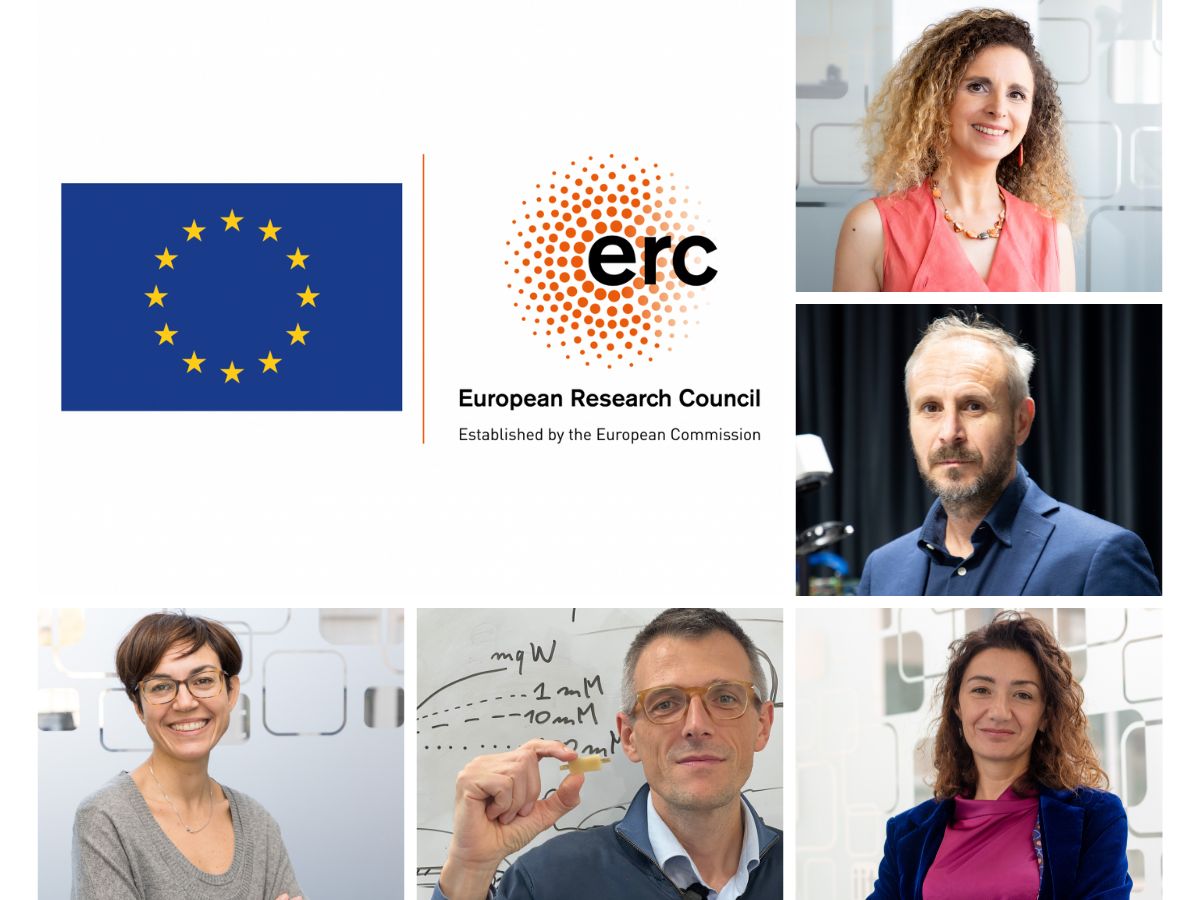
Five new projects for the development of innovative health technologies have been funded by the European Research Council (ERC) at the Istituto Italiano di Tecnologia (IIT-Italian Institute of Technology) at its sites in Milan, Genoa and Naples. The announcement made today by the European body includes, among the 136 winners across Europe: Annamaria Petrozza and Mario Caironi in Milan, Alessandra Sciutti and Giuseppe Vicidomini in Genoa, and Velia Siciliano in Naples. The three female researchers and the two male researchers at IIT will receive Proof of Concept (PoC) grants of approximately €150,000 each, which will allow them to explore the commercial potential of their research. The fields of application include cancer, dyslexia and diagnostics.
Proof-of-Concept (PoC) grants are awards that the ERC allocates to researchers who already hold ERC funding, with the aim of translating frontier research into concrete applications. Today’s announcement completes the 2025 investment round, with 300 PoC projects funded, corresponding to a total investment of €45 million. Italy ranks third with 33 projects, after Germany (51) and Spain (42). Over the course of the year, IIT secured 7 projects – 2 in the first round and 5 in the latest one – ranking first nationwide.
All the new IIT projects aim at the development of new devices for human health, based on frontier methods and discoveries: from quantum technologies to robotics and artificial intelligence, through synthetic biology, edible electronics and new materials for chips with infrared sources.
Genoa – Center for Human Technologies
Giuseppe Vicidomini, Principal Investigator of the Molecular Microscopy and Spectroscopy research laboratory at IIT in Genoa, will lead the BrightMind project, which aims to develop smarter optical microscopes using quantum technologies and artificial intelligence. The new project builds on the experience gained in the previous BrightEyes project, in which Vicidomini developed an optical microscopy instrument equipped with single-photon detectors. The device enables more precise observation of biomolecules within a living cellular system, both in terms of localization and temporal dynamics. To these “eyes,” Vicidomini will integrate a “brain,” namely an acquisition and high-performance computing platform designed to run artificial intelligence algorithms in real time. The smart microscope will be able to autonomously adapt to the sample, correcting distortions caused by optical aberrations and searching for rare biological events. The new device will accelerate the identification of molecules that are key to research on cancer, neurodegeneration and cell biology.
The MERLIN project led by Alessandra Sciutti, Principal Investigator of the CONTACT research unit, will focus on the creation of a technology to support people with dyslexia. The project benefits from the contribution of researcher Dario Pasquali, who will coordinate the development activities of a non-invasive system called INnerSIGHT, which combines the analysis of eye movements and pupil contraction to precisely quantify cognitive effort and fluency during silent and aloud reading. This will provide a valuable indicator for the development of personalized therapies. To date, methods for assessing dyslexia present significant limitations, as they are targeted only at primary school-aged individuals, do not evaluate hidden cognitive load or compensatory strategies developed over time, and do not take silent reading into account. The new system will be validated with the support of the clinical staff of the IRCCS Stella Maris Foundation in Calambrone (Pisa), and through trials involving a large sample of neurotypical and dyslexic adolescents and young adults.
Milan – Center for Nano Science and Technology
Annamaria Petrozza is the Coordinator of the Center for Nano Science and Technology at IIT in Milan and Principal Investigator of the Advanced Materials for Optoelectronic Group research unit. IPER-TECH is the name of her ERC-funded research project, which aims to develop a new technology capable of integrating near-infrared (NIR) light sources with photonic chips based on conventional technologies. The goal is to create portable devices that can be easily customized according to different application needs. Fields of use range from healthcare to environmental monitoring and advanced data communication. Petrozza will work on integrating a new class of materials, known as perovskites – on which she focused her previous ERC funding – with silicon platforms already in use.
Mario Caironi is Principal Investigator of the Printed and Molecular Electronics laboratory at the IIT center in Milan, which in recent years, thanks to ERC support, developed the first examples of edible electronic components, including transistors, sensors and batteries. The new project, entitled EAT, aims to integrate the components already developed into a smart pill for data collection from the gastrointestinal tract; the goal is monitoring digestive processes to support nutritional and metabolic assessments. The work will be overseen by Alessandro Luzio, a technologist in Caironi’s group and an expert in edible electronics. The first step will be the development of hybrid smart pill prototypes, integrating both edible elements and commercially available components; in a second phase, all components of the device will be combined to obtain an intelligent system using exclusively edible materials. This approach has been chosen to enable future non-invasive, safe and repeatable monitoring over time, even outside clinical settings, while eliminating the environmental impact associated with disposable electronic devices.
Naples – Center for Advanced Biomaterials for Health Care
Velia Siciliano is Principal Investigator of the Synthetic and Systems Biology for Biomedicine Laboratory at the IIT center in Naples; her project, entitled CLAUDIA, will be dedicated to the identification of new immunotherapies for ovarian cancer using synthetic biology. The project builds on Siciliano’s previous ERC-funded research aimed at making immunotherapies based on genetically modified T cells, known as CAR-T cells, more resistant in combating tumors. The new project involves the development of smarter CAR-T cells, capable of persisting within ovarian tumor cells and regaining energy when they begin to lose effectiveness. The goal is to advance these immunotherapies to a highly advanced preclinical stage, enabling their application to ovarian cancer and, more broadly, to solid tumors that are difficult to treat.