IIT team reveals how a catalyst works to facilitate hydrogen production from ammonia
The Atomistic Simulations team at the Istituto Italiano di Tecnologia (IIT, Italian Institute of Technology), led by Michele Parrinello, has used artificial intelligence and IIT’s Franklin supercomputer to uncover how a catalyst facilitates hydrogen production from ammonia. The findings, published in Nature Catalysis, could help develop more sustainable systems for producing hydrogen as an energy source.
The scientific community sees hydrogen as a promising option for tackling climate change: its use could reduce reliance on fossil fuels and the resulting carbon dioxide (CO₂) emissions. However, hydrogen poses significant challenges in distribution and storage, making it difficult to use on an industrial scale. One possible solution is to transport hydrogen in the form of ammonia, a substance for which highly efficient handling and transport technologies already exist.
Ammonia would then be converted back into hydrogen when needed through a chemical reaction. To proceed efficiently, however, this reaction requires very high temperatures, which can exceed 600°C. Reaching these temperatures consumes substantial amounts of energy, increasing both the economic cost and the environmental impact of the process.
Catalysts are therefore needed: these substances allow ammonia to break down more quickly and at lower temperatures while maintaining high hydrogen yields.
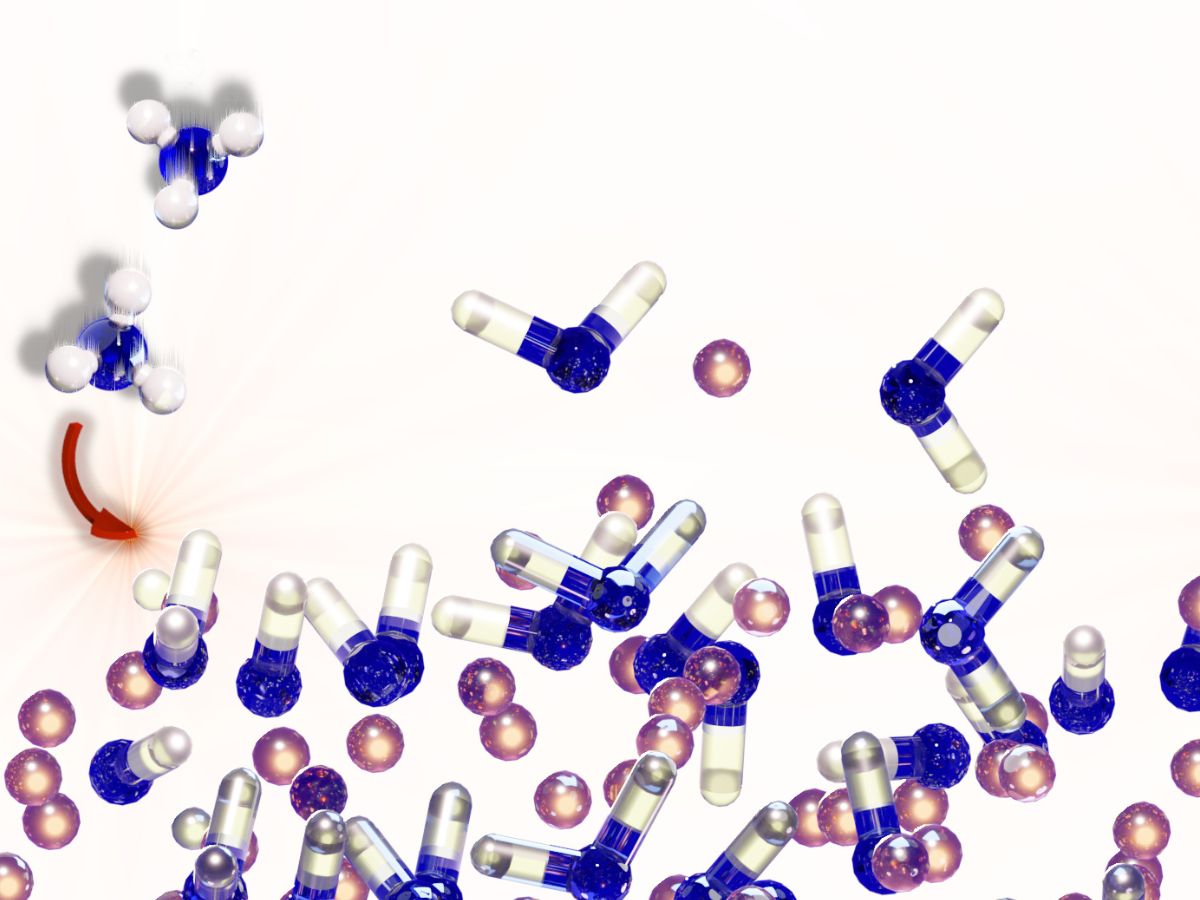
The IIT Atomistic Simulations group used artificial intelligence and the Franklin supercomputer to study molecular motion during the reaction. This enabled the team to uncover how lithium imide works as a catalyst. This substance was already known to facilitate the conversion of ammonia into hydrogen, lowering the required temperature to 480°C.
Earlier models could only investigate reactions in simplified systems and over very short timescales. The new models developed by the IIT team, using methods pioneered by its leader Michele Parrinello, allow researchers to study the reaction under more realistic conditions and over longer timescales, providing a much more accurate picture of how ammonia breaks down.
“Thanks to the models we developed in our laboratory, we were able to identify the fundamental principles underlying this process,” say Umberto Raucci and Manyi Yang, researchers in IIT’s Atomistic Simulationsgroup. “We are now testing these principles in similar systems to understand whether they can be applied more broadly.”
“Testing the fundamental principles identified through our models is just the first step,” comments Michele Parrinello, head of IIT’s Atomistic Simulations group. “In the future, this knowledge could be used to design and develop new catalysts to make hydrogen production from ammonia more efficient. Our ultimate goal is to make energy production increasingly sustainable.”