The research group at the Istituto Italiano di Tecnologia in Pontedera (Pisa), led by Gianni Ciofani, has developed new organic nanoparticles that combine multiple therapeutic functions in a single material for the first time
They can be heated using infrared light, release antioxidant substances, and electrically stimulate cells when activated by ultrasound. These are the new nanoparticles designed and produced by a research group at the Italian Institute of Technology (IIT-Istituto Italiano di Tecnologia), coordinated by Gianni Ciofani, with the aim of providing nanomedicine with a new, versatile and effective therapeutic tool. This is the first time that three properties, being piezoelectric, photothermal and antioxidant, have been combined in a single organic structure measuring 500 nanometres. Described in the international journal ACS Nano, the new nanoparticles could be used to modulate cellular activity, with potential applications in oncology and the treatment of neurodegenerative diseases.
The study was conducted within the framework of “Technologies for Healthy Living”, one of IIT’s Flagship programmes, which aims to investigate and develop health technologies capable of precisely activating and delivering the required therapies. IIT PhD students enrolled at the Sant’Anna School of Advanced Studies in Pisa and researchers from the Italian National Institute of Metrological Research (INRiM) in Turin also contributed to the work.
The research was coordinated by Gianni Ciofani, head of the Smart Bio-Interfaces research group and coordinator of IIT’s Center for Materials Interfaces in Pontedera (Pisa). His research focuses on the development of smart nanomaterials for nanomedicine and microphysiological systems, as well as nanomedicine under altered-gravity conditions.
The new nanoparticles are produced by processing polydopamine, a linear chain of dopamine molecules. Dopamine is the substance that acts as a neurotransmitter in our brain. On its own, dopamine is a small molecule, but when it binds to other identical molecules, it forms an adhesive polymer known as polydopamine, which is already used in biomedicine because of its compatibility with human tissues.
Until now, this organic material had been studied in the form of spherical nanoparticles. In the work conducted by Ciofani and his group, however, it was shaped into nanotubes: hollow structures approximately one-seventieth the length of a grain of sand, with a diameter about 500 times smaller than that of a human hair.
The study showed that changing the shape of the structure also changes its properties. One of the new characteristics is piezoelectricity: when mechanically stimulated, polydopamine generates an electric current. The researchers induced vibrations in the nanotubes using ultrasound, thereby creating a kind of wireless “electrode” that can be implanted in tissues and controlled remotely. This property could also be exploited to create nanoscale or microscale bioelectronic devices.
“The ability to generate an electric current in response to mechanical stimulation is a very rare and important property for an organic, biocompatible nanomaterial,” emphasises Gianni Ciofani, Principal Investigator at IIT. “Piezoelectricity had never previously been observed in polydopamine: the tubular shape allowed a property that is absent in spherical nanoparticles made from the same material to emerge.”
The particles’ other two properties derive from the characteristics of dopamine in its polymerised form, polydopamine. It can absorb infrared light and heat up, while ultrasound stimulation causes it to release individual dopamine molecules. These two effects can be used, respectively, to stimulate cellular activity in tissues, for example, the release of intracellular calcium, which underlies communication between cells; and to produce an antioxidant effect, protecting cells from oxidative stress and promoting their survival.
Matteo Battaglini, first author of the study, explains: “The nanotubes release dopamine in a controlled manner and respond to external stimuli such as ultrasound and infrared light, integrating multiple functions into a single platform.”
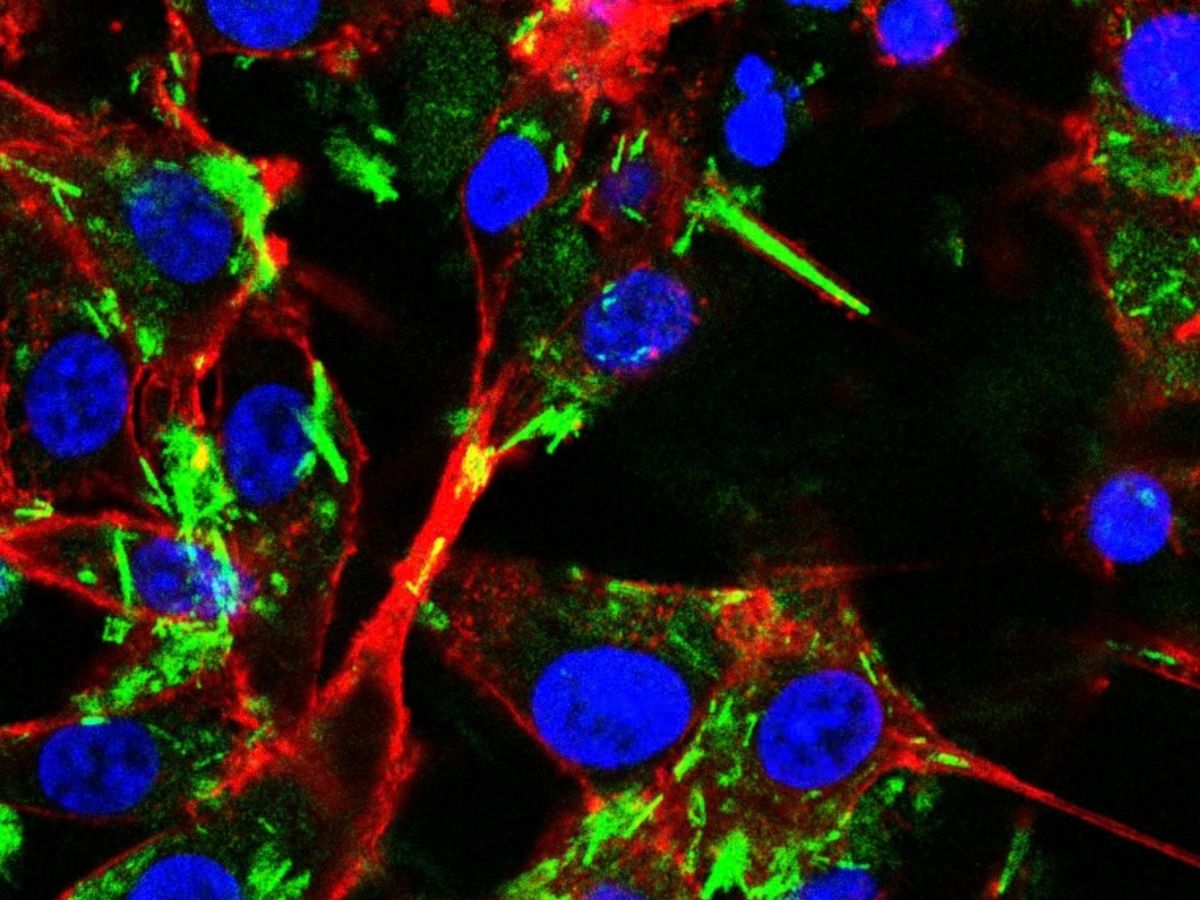
To assess the biocompatibility of the nanotubes, the researchers tested them on cultured cells. They observed that the nanostructures were incorporated by the cells without interfering with their normal activity.
Polydopamine nanotubes therefore represent a new class of multifunctional nanomaterials that could be used in regenerative medicine, neurostimulation and the development of bioelectronic devices, as well as potentially providing a tool for the controlled delivery of therapeutic molecules to the nervous system.
Reference: M. Battaglini, A. Marino, T. Curiale, A. Carmignani, M. Bernardeschi, M. Emanet, M. C. Ceccarelli, F. Catalano, F. Drago, S. Marras, G. Pugliese, R. Carzino, B. Torre, G. Ciofani. “Polydopamine Nanotubes: Multifunctional Smart Nanotransducers for Cellular Activity Modulation.” ACS Nano https://doi.org/10.1021/acsnano.6c05512