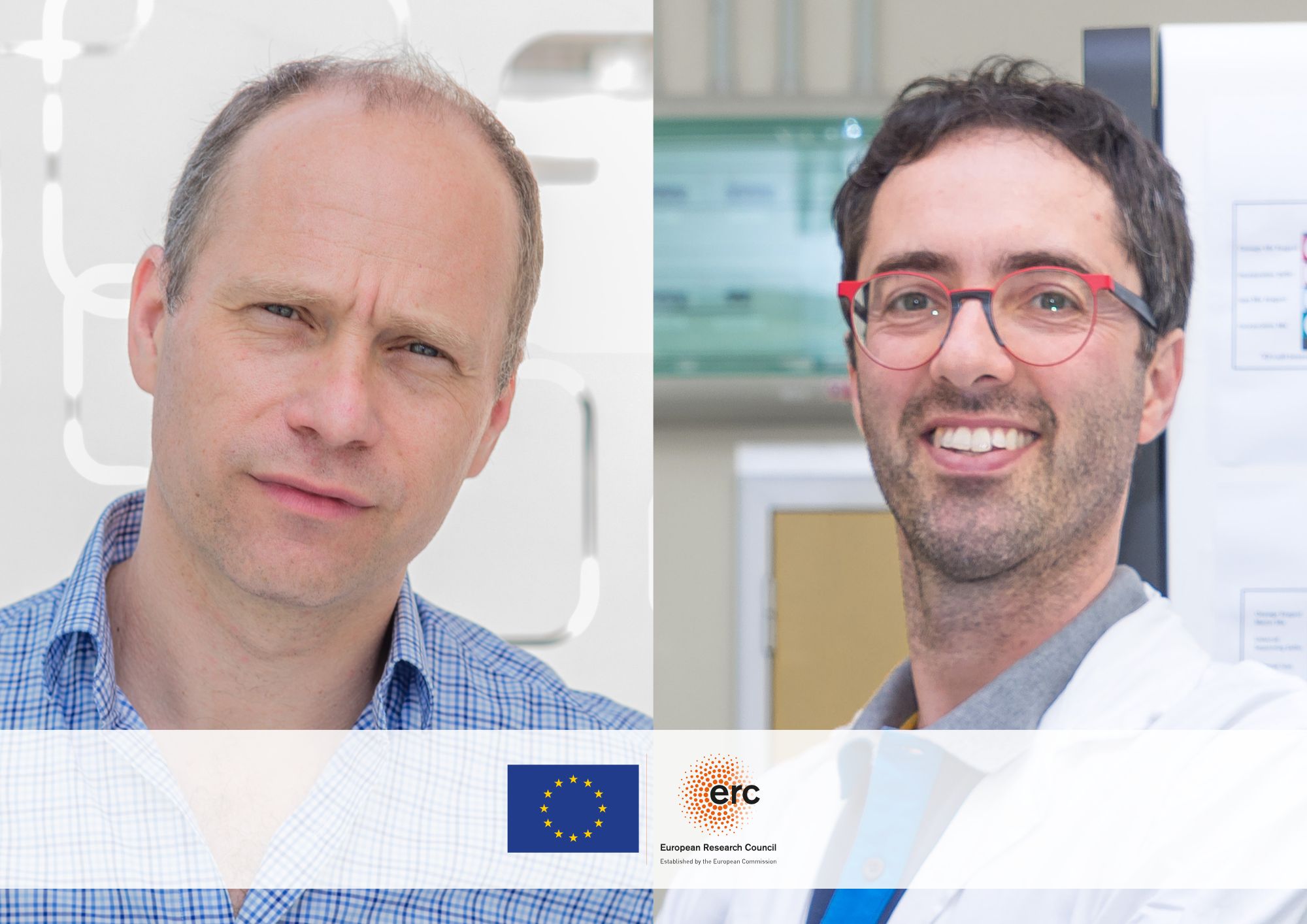
Francesco Papaleo will investigate the mechanisms through which the brains of different individuals “tune in” to one another in order to recognize and respond to others’ emotions. Massimiliano Pontil will develop new algorithms to study complex phenomena over long time horizons, going beyond current machine learning methods
The brain mechanisms that make human beings empathetic and social, and new intelligent algorithms capable of predicting large-scale future phenomena: these are the two core themes of the research programs that Francesco Papaleo and Massimiliano Pontil, researchers at the Italian Institute of Technology (IIT) in Genoa, will carry out thanks to the prestigious European Research Council (ERC) Advanced Grants, worth a total of €5.5 million. Both projects are expected to have tangible impacts: on one hand, advancing the understanding of disorders characterized by socio-emotional impairments; on the other, enabling the prediction of the evolution of complex physical phenomena over time, such as climate dynamics.
The ERC officially announced the results today, awarding 319 Advanced Grants across 24 European Union member states to researchers of 33 different nationalities, for a total investment of €838 million under the Horizon Europe programme. Papaleo and Pontil are among the 29 Italian researchers receiving funding and among the 19 who will conduct their research in Italy.
The Advanced Grant is a highly competitive funding scheme awarded by the ERC to researchers with an established track record of significant scientific achievements over the past decade. The grant provides senior researchers with the opportunity to pursue ambitious, curiosity-driven projects that may lead to major scientific breakthroughs. The ERC estimates that this investment will create approximately 3,000 jobs within the funded research teams.
Francesco Papaleo is Head of the Genetics of Cognition Research Unit at IIT in Genoa and is affiliated with the IRCCS Ospedale Policlinico San Martino in Genoa. Originally from Sicily and holding a degree in Pharmacy from the University of Padua, Papaleo spent many years conducting research abroad, in both France and the United States. His work focuses on the mechanisms underlying cognitive and social impairments relevant to psychiatric and neurodevelopmental disorders and has consistently been supported by prestigious funding bodies, including the Telethon Foundation in Italy and the National Institutes of Health (NIH) in the United States. This is his first ERC grant and will support the EmotionalBrainS project, whose primary objective is to identify and characterize evolutionarily conserved brain mechanisms that regulate socio-emotional behaviours and the recognition of emotions in others. The project aims to understand how the brains of different individuals coordinate during social interactions and how these processes may be disrupted in pathological conditions, with potential implications for understanding socio-emotional disorders in humans. Papaleo will employ state-of-the-art technologies in genetics, brain imaging, and optogenetics.
Massimiliano Pontil heads the Computational Statistics and Machine Learning Unit at IIT in Genoa and is also co-director of the ELLIS Unit Genoa, a joint initiative between IIT and the University of Genoa dedicated to excellence in artificial intelligence research. Pontil is also a Professor at University College London (UCL) and a member of the UCL Centre for Artificial Intelligence. He has held research positions at leading international institutions, including Cambridge University, École Polytechnique in Paris, and MIT, and is recognized as one of the foremost experts in the theoretical foundations of machine learning. The ERC funding, awarded for the LEO project, will be used to develop new machine learning algorithms that are efficient, reliable, and interpretable, and that can incorporate the laws of physics into the learning process. These tools will make it possible to describe and predict the dynamics of complex systems over long-term horizons using less data and consuming less energy. While the methods developed will be general in nature, their applications range from climate science to drug discovery and protein design.