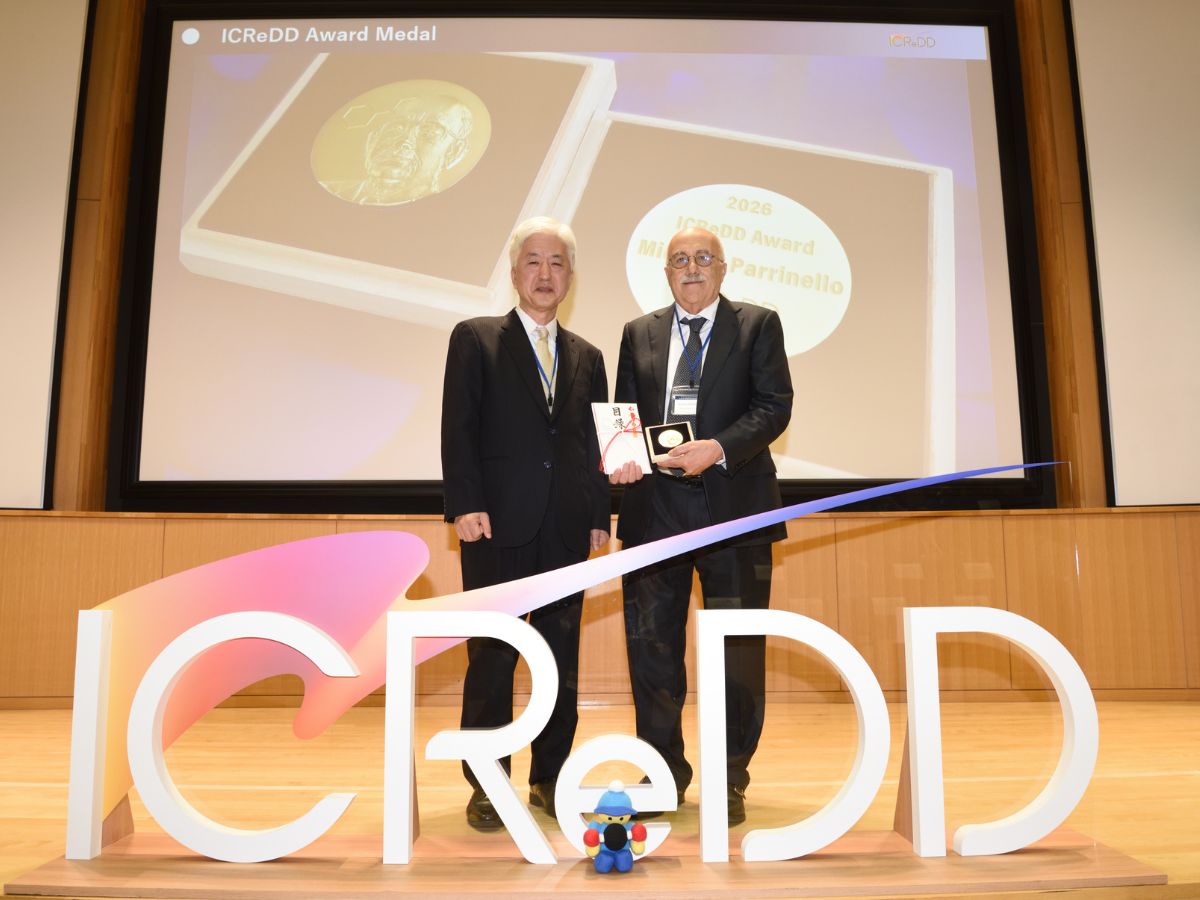
The ceremony took place on 7 October during the international ICReDD symposium at Hokkaido University in Sapporo, Japan
Parrinello is Principal Investigator and coordinator of the “Atomistic Simulations” Research Unit at IIT’s Center for Human Technologies in Genoa, where he leads a group of 20 researchers from six countries around the world, with an average age of 30.
The Akira Suzuki Awards were established in 2021 to celebrate Professor Akira Suzuki’s receipt of the 2010 Nobel Prize in Chemistry and his 90th birthday. Born in 1930 in a small town in Hokkaido, Suzuki began developing chemical reactions in the late 1970s in which carbon atoms are joined together to create new compounds, identifying palladium as a catalyst. Palladium has the property of facilitating the reaction without becoming part of the final product. He shared the Nobel Prize with Richard F. Heck of the University of Delaware, USA, and Ei-ichi Negishi of Purdue University, USA.
The Akira Suzuki Awards aim to recognize outstanding contributions to research in the discovery of chemical reactions, defined in the broadest sense, and to contribute to the advancement of science and technology. They comprise two honours: the Akira Suzuki Award, for scientific contributions in the field of experimental chemistry, and the ICReDD Award, for achievements in the fields of computational (theoretical) chemistry and information science.
The Award’s Organising Committee selected Professor Michele Parrinello as the winner of the ICReDD Award from among the candidates nominated by members of the Selection Committee. During the ceremony, Parrinello gave a seminar entitled “The Science of Catalysis”.
Catalysis is, indeed, one of the areas of study pursued by Parrinello and his group at IIT. For example, they study catalysis for hydrogen production from ammonia, where they have recently revealed how two different catalysts work and opened up new prospects for more sustainable energy systems (Nature Catalysis, 2023; ACS Catalysis, 2025), and computational enzymology, for which the group has developed a computational tool useful for improving plastic degradation and recycling technologies (Chem, 2026).
Michele Parrinello’s name, however, is associated with the “Car–Parrinello” method, invented together with Roberto Car in 1985, which revolutionized the way numerical simulations of molecular dynamics are carried out by including electronic aspects, broadening the scope and predictive power of atomistic simulations. The method was first presented in November 1985 in the journal Physical Review Letters(doi.org/10.1103/PhysRevLett.55.2471) and made it possible to accelerate the study of molecular dynamics while taking electronic motion into account. Before then, molecular systems were studied by separating the behaviour of electrons from that of the particles in the nucleus, neutrons and protons. The Car–Parrinello method made it possible to combine the calculation of these two types of behaviour into a single process, thus speeding up the basic tools of computer simulations, which have now become fundamental to contemporary science. That work was the result of research conducted by Roberto Car and Michele Parrinello at the International School for Advanced Studies (SISSA) in Trieste.
Thanks to that important contribution, in 2024 Parrinello appeared among the possible candidates for the Nobel Prize in Chemistry, according to Clarivate’s Citation Laureates list and some rumours within the scientific community.
The Akira Suzuki Award is the latest award won by Parrinello, whose contribution to the advancement of scientific knowledge is widely recognised internationally. His other awards include: in 2025, the ESI Medal from the Erwin Schrödinger Institute for Mathematics and Physics in Austria and the USI Medal from Università della Svizzera Italiana; the Natta Award from Politecnico di Milano in 2021; the Benjamin Franklin Medal in Chemistry from the Franklin Institute in Philadelphia in 2020; the Dreyfus Prize in the Chemical Sciences from the Camille and Henry Dreyfus Foundation in New York in 2017; the Enrico Fermi Prize from the Italian Physical Society in 2012; the Dirac Medal awarded in 2009; and the American Chemical Society Award in Theoretical Chemistry in 2001.