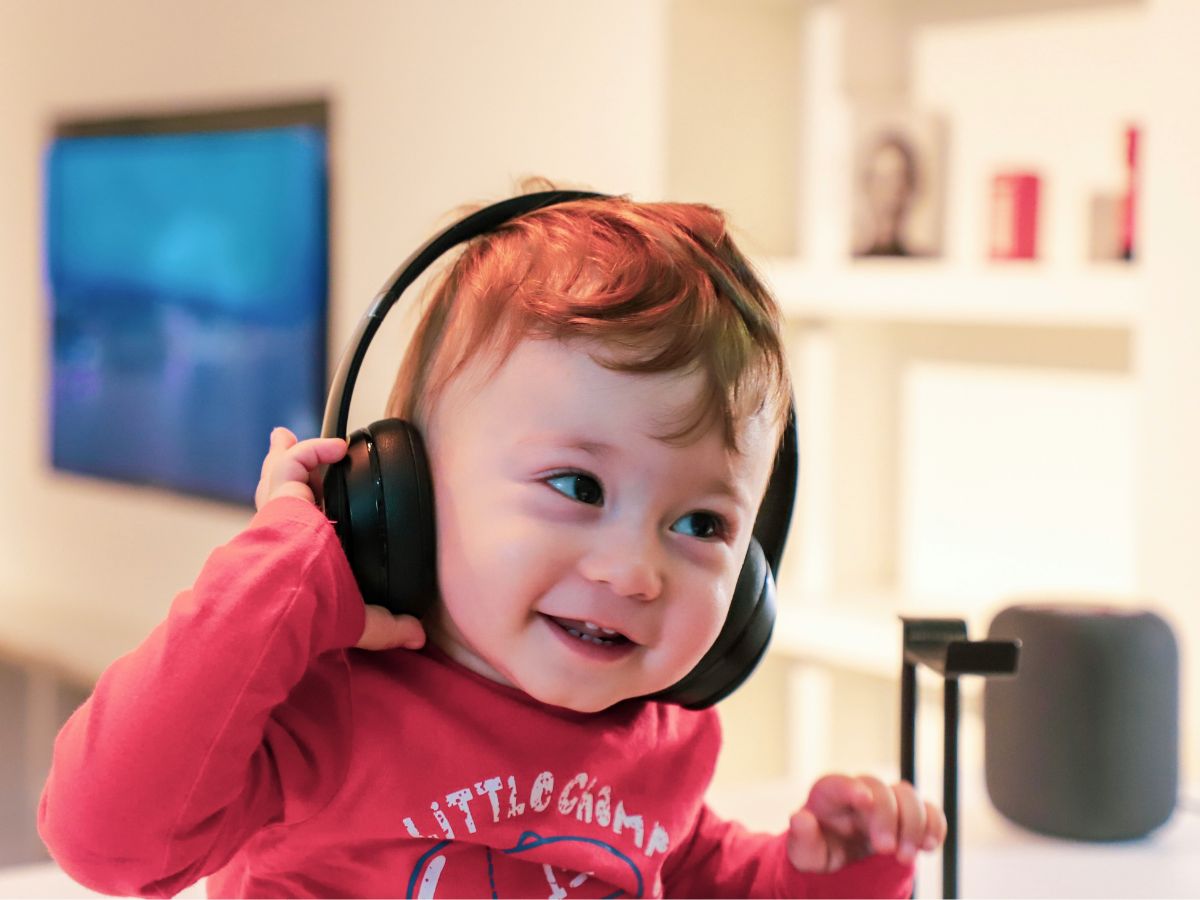
A study coordinated by Italian Institute of Technology in Rome suggests babies’ brains recognize music from as young as three months of age, while spontaneous movements to music emerge by their first birthday and their ability to match movements to it develops later
Researchers at the Italian Institute of Technology (IIT) in Rome have discovered that music begins to shape the way we move within the first year of life. Their study, published previously as a Reviewed Preprint in eLife and appearing today as the final Version of Record, provides insights into how the developing brain gradually transforms music into spontaneous movements. It suggests that while our brains are able to process music early in infancy, spontaneous movements to music increase only towards the end of the first year, and coordinating these movements in time with the beat develops later still.
The research was led by Giacomo Novembre, Principal Investigator of the Neuroscience of Perception and Action Lab at the Center for Life Nano- & Neuro-Science of the Italian Institute of Technology (IIT) in Rome. The study’s first author is Trinh Nguyen, an Affiliated Researcher at the Neuroscience of Perception and Action Lab at IIT in Rome and a Senior Research Fellow at the University of Vienna, Austria.
Musicality – our penchant for perceiving, appreciating, and producing music – is increasingly recognized as a fundamental aspect of human nature. At the heart of musicality is our engagement with music, which can be broken down into two components of neurocognitive development: a sensory component – the ability to perceive and recognise music – and a motor component – the ability to move (in time) to music. But when and how we develop musicality as infants remains largely unknown.
“This lack of knowledge is partly due to the fact that few to no studies have explored brain activity and spontaneous movements in response to music at the same time,” explains lead author Trinh Nguyen, who spent three years as Researcher in the Neuroscience of Perception and Action Lab at the Istituto Italiano di Tecnologia (Italian Institute of Technology; IIT), Rome, Italy, and today Senior Research Fellow at the University of Vienna, Austria. “Studying both the sensory and motor components of musicality in infants would give us a better understanding of how we learn to transform the perception of music into movement.”
To address this gap, Nguyen and colleagues played music to infants – 79 in total, aged three, six and 12 months old – and took EEG recordings and movement measurements to understand their neural (auditory) and motor responses, respectively. The music included instrumental refrains of children’s songs (referred to simply as ‘music’), shuffled versions of the same songs (‘shuffled music’), and high and low-pitched versions of the songs, as pitch may play a role in auditory-motor engagement in infancy.
By comparing the EEG responses elicited by ‘music’ to those elicited by ‘shuffled music’, they found that all age groups had an enhanced auditory response to ‘music’, indicating that music processing starts early in development. This finding is in line with one of their hypotheses: that auditory responses would be enhanced when triggered by music compared to shuffled music. This is based on the notion that musical structure, which was disrupted in the shuffled music, is essential to attract infants’ attention towards predictable events.
The researchers then estimated and compared the infants’ spontaneous movements in response to the music types using automated video-based motion-tracking, specifically open-source software called DeepLabCut. Applying a dimensionality reduction technique called principal component analysis, they categorised these movements into 10 principal movements (PMs) including: front-back rocking, side sway, proto-clapping, leg-kicking, up-down rocking, arm-pedalling, feet-kicking, whole-body wiggling, feet-shuffling, and feet-pedalling.
A data modelling technique highlighted a significant interaction between the type of music and age group, showing that only 12-month-olds exhibited higher quantities of movement in response to ‘music’ compared to ‘shuffled music’ across all PMs. When the team explored these movements further, they found that this response involved mostly movements of the upper body and/or upper limbs – specifically front-back rocking, side sway, proto-clapping, up-down rocking, and arm pedalling.
In comparison, infants aged three and six months old did not exhibit significantly different quantities of movement in response to ‘music’ vs ‘shuffled music’ in any of the PMs. These results were unchanged across all age groups when the researchers compared their movements in response to the high and low-pitched versions of the music.
“Across the first year of life, infants seem to consistently move their lower body while slowly increasing their capacity for more complex upper-body and whole-body movements while seated, as we saw in the 12-month-olds,” Nguyen explains. “We believe this increasing complexity is linked to the gradual maturation of the dorsal auditory stream in the brain, a pathway that has previously been suggested to play a crucial role in rhythmic entrainment and beat perception.”
Notably, the team also found there was no evidence that infants of any age coordinated their movements in time with the music. This points to a gradual refinement of human motor control: the system first develops the capacity to control individual muscles, while the capacity for more coordinated, whole-body movements follows later.
“We’ve shown that, much like the auditory encoding of music, moving to music emerges early in development. This may reflect a biological or early-developing predisposition that eventually leads to dance-like behaviours, although these motor responses remain underdeveloped before 12 months of age,” concludes senior author Giacomo Novembre, Principal Investigator in the Neuroscience of Perception and Action Lab at IIT. “This work provides initial insights into how the developing brain gradually transforms music into spontaneous movements. Future research is now needed to extend our characterisation of music-driven movement beyond the first year of life and explore what continues to be its mysterious functional significance.”
The research was supported by funding from the European Research Council (ERC), through a grant awarded to Giacomo Novembre, and was carried out within the Italian Institute of Technology’s Brain and Machines Flagship Programme. Trinh Nguyen and Roberta Bianco also received support from the Marie Skłodowska-Curie Actions under Horizon Europe.